
LLM visibility refers to how often and how prominently your brand, website or content appears in responses generated by AI-powered search and conversational platforms such as ChatGPT, Google Gemini, Perplexity and other large language model (LLM) systems.
Unlike traditional SEO, where visibility can be measured through rankings, impressions and clicks, LLM visibility can involve brand mentions, citations, source links, recommendation frequency and the context in which your business is presented.
Learning how to measure LLM visibility helps businesses understand how they are represented across AI search experiences and identify opportunities to improve their content, authority and online presence.
This guide explains practical ways to track LLM visibility, the metrics worth monitoring, useful tracking methods and how LLM visibility measurement can complement traditional SEO and generative engine optimization.
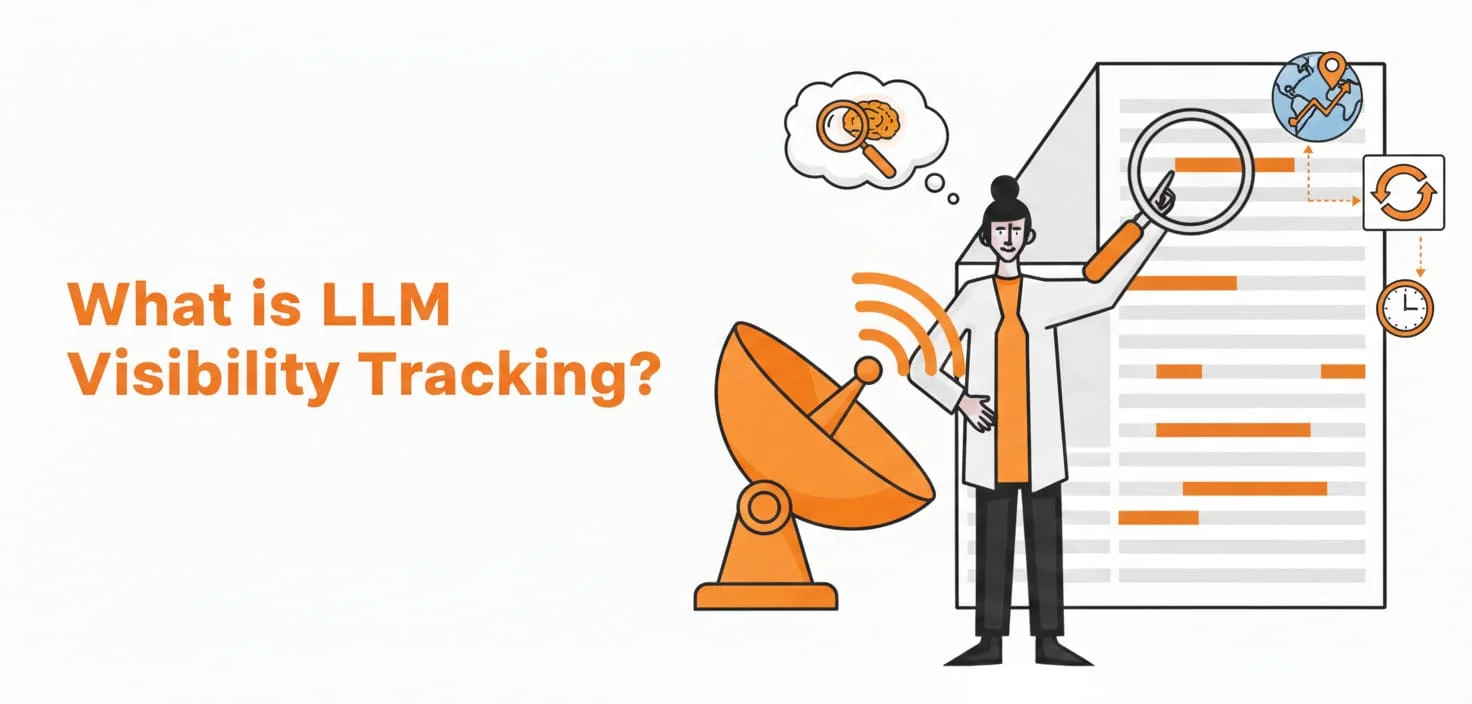
What is LLM Visibility Tracking?
LLM visibility tracking is the process of monitoring how a brand, website or business appears in responses generated by AI-powered search platforms.
It can include measuring:
- How frequently a brand is mentioned
- Whether a website is cited as a source
- Which pages or domains are referenced
- How the brand is described
- How consistently the brand appears across different prompts
- How competitors are represented in the same responses
For example, a business may test relevant questions across ChatGPT, Gemini and Perplexity to see whether its brand is mentioned and which sources are used to support the generated answer.
This type of monitoring provides a different view of search performance. Instead of focusing only on traditional rankings, businesses can analyse their AI search visibility and understand how their content and brand are represented within generative search experiences.
LLM visibility tracking can therefore complement traditional SEO and broader generative engine optimization strategies.
How to Measure LLM Visibility
Manual Tracking Methods
Manual LLM querying starts with prompt library creation containing branded vs non-branded query testing across ChatGPT, Claude, Perplexity, and Gemini.
Use incognito mode testing with query parameter variations for response consistency checking, documenting results in spreadsheet documentation with time-stamped tracking logs.
Conduct query variation testing weekly, including competitive comparison queries and product-specific prompts for baseline measurement establishment.
Screenshot capture workflows and manual citation counting provide qualitative response analysis, though response archiving systems become unwieldy at scale, making this suitable only for initial contextual mention evaluation.
Automated Monitoring Approaches
LLM rank tracking software enables API-based monitoring with scheduled query running across platforms, eliminating manual effort through automated prompt execution.
Tools provide continuous monitoring systems with webhook notifications when citation patterns shift, feeding dashboard visualization for trend analysis automation.
Programmatic data collection through multi-LLM API integration supports bulk prompt testing with historical data retention spanning months.
Automated reporting pipelines include sentiment scoring and time-series analysis tools, with alert threshold configuration for reputation changes. This scalable tracking infrastructure handles thousands of queries through data aggregation systems impossible with manual methods.
Key Metrics to Monitor
Track citation frequency rate (how often you appear) and visibility share percentage across prompt categories, measuring position in response for contextual placement analysis.
Monitor mention context sentiment with brand sentiment polarity scoring, flagging negative sentiment flags for immediate response.
Core metrics to track:
- Citation frequency rate
- Visibility share percentage
- Source attribution accuracy
- Brand sentiment polarity
- Share of voice vs competitors
Source attribution accuracy and citation link inclusion reveal answer relevance score quality. Share of voice metrics compare your response inclusion rate against co-mention competitors, while query coverage percentage shows topic breadth.
Citation diversity across topics and temporal visibility trends identify content gaps, with competitor displacement metrics revealing strategic opportunities in recommendation strength indicators.

Best LLM Tracking Tools
For Agencies
Agencies require multi-client dashboard management with white-label reporting capabilities and client permission controls for professional deliverables.
Top platforms offer scalable monitoring infrastructure handling 50+ clients through bulk query management and agency pricing tiers with unlimited user seats.
Look for custom branding options, API access for integrations with existing systems, and automated client deliverables reducing manual work.
Essential agency features:
- Multi-client dashboard management
- White-label reporting
- Custom branding options
- Cross-client benchmarking
- Dedicated account management
Essential features include cross-client benchmarking, customizable report templates, and client-specific alerting. Agency partner programs with reseller opportunities and dedicated account management provide competitive advantages, while SLA guarantees ensure reliable consolidated billing systems and historical data exports.
For Brands & In-House Teams
In-house teams prioritize cost-effective pricing models with single-brand monitoring focus and simplified user interface for non-technical users.
Essential features include Slack/Teams notifications, integration with existing MarTech stack like Google Analytics connections and SEO tool integration.
Look for departmental access controls enabling content team workflows, PR crisis monitoring, and executive dashboard views.
DIY setup processes with training resource availability accelerate adoption, while stakeholder report sharing facilitates cross-functional alignment.
Campaign impact tracking and product launch tracking measure initiative ROI. Freemium tier options and monthly usage limits suit budget-conscious teams, with CRM data sync enriching competitive intelligence feeds.
Tool Comparison
Otterly.ai excels in sentiment analysis accuracy with real-time vs batch processing for immediate alerts, covering ChatGPT, Perplexity, and Claude with strong citation source identification.
Parse.gl offers superior historical data retention periods (12+ months) and data export formats for custom analysis, though implementation complexity requires technical resources.
Mangools AI Search Watcher provides cost-effective entry with free trial availability and simplified platform coverage breadth.
LLMRefs focuses on citation tracking with update frequency rates multiple times daily.
Evaluate pricing structure transparency, customer support quality, and third-party integrations against your platform reliability scores requirements and feature roadmap transparency needs.
Citation Tracking from Sources
Citations are an important part of LLM visibility because they show which websites and pages AI systems use as sources when generating responses.
To measure citation performance, record:
- The URL cited
- The page topic
- The AI platform
- The prompt that generated the citation
- How frequently the URL is cited
- Which competitors are cited for the same topic
- Whether the cited information accurately represents your brand
This analysis can reveal which types of content are being referenced and where content gaps may exist.
For example, if competitors are consistently cited for questions related to a particular service while your website is rarely referenced, review the relevant content for depth, clarity, topical relevance, factual support and internal linking.
Strong technical SEO and well-structured content can also make your information easier for search engines and AI systems to understand. Businesses interested in the broader relationship between AI search and SEO can also review our guide to Generative Engine Optimization agencies in London.
Citation tracking should therefore be treated as one part of a wider LLM SEO and content optimization strategy, rather than as a standalone ranking metric.
Sentiment Monitoring in AI Outputs
Sentiment polarity analysis uses natural language processing (NLP) to classify LLM responses into positive/negative/neutral categories, with emotion detection algorithms providing contextual sentiment understanding beyond simple scoring.
Brand reputation monitoring requires tracking praise vs criticism ratios with sentiment shift alerts triggering when complaint pattern identification exceeds crisis detection thresholds.
Monitor temporal sentiment changes through sentiment trend tracking, comparing your perception gap analysis against industry benchmark sentiment.
Product-specific sentiment breakdown reveals sentiment driver identification opportunities, while comparative sentiment analysis shows competitive positioning.
Actionable insight extraction focuses on review aggregation in LLM responses, understanding how sentiment impact on recommendations influences AI-generated advice about your brand.
Setting Up Your LLM Tracking System
Building Your Query List
Start with branded query variations testing direct mentions, then expand to non-branded industry queries where prospects discover solutions.
Include competitor comparison prompts and “best of” category queries capturing consideration-stage traffic.
Query types to include:
- Branded query variations
- Non-branded industry queries
- Competitor comparison prompts
- Problem-solution formats
- Product recommendation requests
Structure problem-solution query formats addressing customer pain points with question-based query structures mirroring natural conversations.
Add product recommendation requests, transactional intent queries, and alternative solution queries spanning the customer journey mapping.
Incorporate long-tail conversational prompts, use-case scenario queries, and feature comparison questions. Plan seasonal query variations and geographic query targeting, creating informational query templates for awareness-stage questions and decision-stage prompts covering pricing inquiry formats.
Tracking Frequency
Implement daily monitoring schedules for high-priority branded queries with real-time alert systems catching reputation issues, while weekly tracking cadence handles competitive monitoring frequency and campaign-aligned measurement.
Conduct monthly comprehensive reviews identifying trend patterns through quarterly benchmark assessments.
Balance automated vs manual checks for resource allocation optimization within tracking budget management constraints.
Recommended tracking schedule:
- Daily: High-priority branded queries
- Weekly: Competitive monitoring
- Monthly: Comprehensive reviews
- Quarterly: Benchmark assessments
Use crisis-response tracking intervals (hourly) during product launches or industry news trigger events, returning to normal weekly patterns afterward.
Batch low-priority queries for efficiency while maintaining peak traffic period monitoring. Adjust seasonal tracking during baseline establishment timeframes, with annual strategic reviews evaluating algorithm update response effectiveness and overall program ROI.
Reporting & Analysis
Build executive summary dashboards with KPI trend visualization showing month-over-month comparisons and competitive benchmark reporting for quick stakeholder consumption.
Create stakeholder-specific reports tailoring citation share analysis and sentiment score cards to departmental needs, using visual storytelling techniques for narrative-driven analysis.
Include data-driven recommendations from actionable insight extraction, prioritizing content gap identification through optimization priority ranking.
Implement performance attribution modeling connecting LLM visibility to ROI measurement frameworks and cross-channel performance correlation with SEO and paid search according to research from Stanford.
Use automated report distribution for team alignment, incorporating custom metric tracking for strategic planning inputs that guide quarterly initiatives and resource allocation decisions.
Conclusion
Measuring LLM visibility gives businesses another way to understand how their brand and content are represented across AI-powered search experiences.
A practical measurement process can start with a focused set of prompts, manual testing and consistent documentation. As the number of queries and platforms grows, automated LLM tracking tools can make monitoring and historical comparison more efficient.
The most useful measurements include brand mentions, citations, query coverage, competitive visibility and the context in which a brand appears. These metrics can complement traditional SEO data and provide additional insight into AI search visibility.
LLM visibility should be treated as an ongoing measurement process rather than a one-time test. Regular monitoring can help identify content gaps, citation opportunities, and changes in how AI platforms represent your business.
For a broader look at how businesses can prepare their websites for AI-powered search, see our guide to generative engine optimization agencies in London.
FAQ
How much do LLM tracking tools cost?
Pricing ranges from free tiers (limited queries) to $99-299/month for SMBs, and $500-2,000+/month for enterprise solutions with unlimited tracking and advanced features according to industry analysis from Gartner’s MarTech research.
Can I track LLM visibility for free?
Yes, through manual querying across ChatGPT, Claude, and Perplexus, documenting results in spreadsheets. Free tiers from Mangools AI Search Watcher and Parse.gl offer limited monthly queries for basic monitoring.
How often should I check my LLM visibility?
Daily for branded queries during campaigns or crises, weekly for competitive monitoring, and monthly comprehensive reviews for strategic planning and trend identification.
What’s the difference between LLM tracking and traditional SEO?
SEO tracks rankings in search engine results pages (SERPs) with clickable links; LLM tracking measures citations within AI-generated text responses where users may never click through to your site.
Do I need different tools for different LLMs?
Leading platforms like Otterly.ai and Parse.gl support multiple LLMs (ChatGPT, Claude, Perplexity, Gemini), eliminating the need for separate tools per platform.
How long does it take to see changes in LLM visibility?
Expect 4-8 weeks after content optimization or link building, though high-authority publications may appear in citations within days as LLM models update their training data.


